
It’s a rainy morning in Louisville now. But 25 years ago, I remember a clear blue sunny day as I sped down U.S. 1 in New Jersey, heading to the emergency backup facility for The Wall Street Journal, because the lower Manhattan building I had worked in for more than a decade was in ruin.
The World Trade Center had collapsed, the result of al Qaeda terrorists using passenger jets as missiles, and my office was in the World Financial Center, directly across the street.
See the picture below?
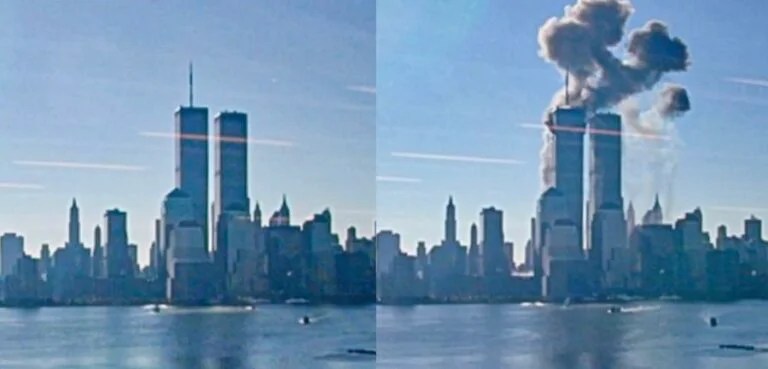
The one on the left was taken at 8:45 a.m. The one on the right was taken at 8:46 a.m. The building I worked in is directly in front of the south tower, literally across the street.
I normally would have been getting off the PATH train (the New Jersey to New York subway system) at this time, but I was running late, and as I was about to leave my house in central New Jersey, my wife called me in to the living room to see the live television broadcast.
At that second, I knew that there was no point in going into the office, because years earlier I had been across the street from another terrorist attack. On Feb. 26, 1993, I was working at my desk when an explosion shook our windows. A bomb-filled van had gone off across the street in the World Trade Center garage, the first attempt by al Qaeda to bring the towers down. This is what I saw when I left the office that evening:

Obviously, the area was restricted. I had to walk north to a midtown train station to get home, because the subway system in lower Manhattan was shut down.
So on Sept. 11, 2001, I knew I had to get to work, and I knew work meant going to a non-established emergency newsroom in New Jersey.
That newsroom, however, hadn’t been fully tested. We’d just introduced completely new editing software at the Journal, and we had a testing/training room with several workstations.
When I got to South Brunswick, the IT staff was busy creating a new newsroom, having gone to practically every computer retailer in Central Jersey and buying every machine they could pick up.
I led the Journal’s copydesk at the time, with a staff of about 50 people, and took calls from reporters in the field, sorted through memos and messages to senior editors, and relayed the little information I knew to the Journal’s publisher and CEO, who was in Hong Kong at the time for an event with our Asian edition.
Here’s one of the memos:

My boss, Jim Pensiero, finally arrived in South Brunswick. He was in the office in New York when the planes hit. He hopped a ferry nearby to New Jersey, and watched as debris fell and as people jumped from the tower to their deaths. He and thousands of New Yorkers were eyewitnesses to mass murder. But following directions by his boss, he arrived in South Brunswick and led us through the stressful hours that followed.
More editors came in. People who were used to doing specific jobs were assigned different roles. Eventually, more editors and reporters arrived. We spent the rest of the day gathering information, putting stories together, consulting with our displaced staff and coordinating articles with reporters and editors throughout the Journal empire, especially with the team in Washington, D.C., which was dealing with its own trauma when a hijacked plane hit the Pentagon.
We produced this:

I have the actual plate of this page that was placed on one of our printing press, providing tens of thousands of people a physical historical record of what happened that day.
The Journal won the Pulitzer Prize for what we did on Sept. 11, 2001.
I never worked in New York City again. My staff was permanently relocated to New Jersey in the facility pictured below:

I think of many horrible things that have happened in my journalism career. I remember family members calling my wife to make sure I was still alive, because they knew I worked across the street from the towers. I worked in Louisville where, after I left, there was a mass shooting. I worked in Pennsylvania politics, where years after I left, someone I’d encountered took a gun and committed suicide on live television. I worked with a guy who was banned from the office and later went on a rampage, killing two cops and a pizza parlor employee before dying in a shootout. I watched a riot in front of my building at The Washington Post when Donald Trump was inaugurated the first time. Here’s a picture I took from my office:

I was at the Post on Jan. 6, 2021, when rabid MAGA rioters desecrated the Capitol Building.
Nothing compares to Sept. 11. Nothing ever will.
I placed the book at the top of this post because it’s an excellent presentation of what happened that day. I appear in several pages describing my role in producing the paper.

Leave a Reply