
There’s a lot to unpack on the rush by Louisville Mayor (and Trump quisling) Craig Greenberg and his developer-political funders to build a data center in the western part of Louisville. (That’s the planned site in the above photo.)
But first, let’s listen to an expert on the strategy by tech bros and their developer friends to place centers in Ohio communities:
Also note what he says at another meeting:
Obviously, data centers aren’t being built because there’s a huge public demand to be ahead of the curve on the artificial intelligence boom. It’s far more sinister than that.
The rush by developers and tech bros is to promote a fantasy future that will allow them to be the first ones in on a Wall Street initial public offering that promises the potential of millions, maybe even billions, of dollars, for a select few early investors. Those investors have no intention of protecting the interests of people who live in or near communities that will deal with the scars of land molestation, huge electric bills that are tied to these projects and the damage to water supplies, even though the greed heads know higher bills and environmental damage are the reality of what will be left behind.
If you don’t know what’s happening or why, here’s an AI summary (ironic, isn’t it?):
The PowerHouse Louisville project is a massive 154-acre hyperscale data center campus under development on Camp Ground Road just west of Shively, Kentucky.
Project Overview
- Developers: A joint venture between Louisville-based Poe Companies and Virginia-based PowerHouse Data Centers.
- Location: Camp Ground Road in the Rubbertown industrial chemical cluster of southwest Louisville/Shively area.
- Size: Approximately 1.6 to 1.8 million square feet spanning seven buildings, including data server warehouses, an office, and utility/security structures.
- Timeline: Approved by the Louisville Planning Commission in early 2026, with the first phase expected to become operational in late 2026.
Resources and Impact
- Power Demand: Projected to consume about 400 megawatts (MW) of electricity at full capacity—equivalent to the annual usage of roughly 280,000 residential customers. Initial power availability of 130 MW is tied to upcoming LG&E substation upgrades.
- Water Usage: Designed to utilize infrastructure from the Louisville Water Company.
- Community Response: Met with local resident pushback and public concern regarding high electricity and water consumption, as well as industrial proximity, though developers and planning groups pushed the project forward.
Even the summary shows there is resistance from people who live around the community affected.
So why is this a racial issue? Take a look at the next YouTube video:
At the five minute and 30 second mark, it identifies the “Blackest place” in Kentucky as Shively (54.57 percent).
We know that when developers want to locate something in an area that’s not in the best interest of the community, they put it in or near a predominantly Black area. Greenberg and the Poe Companies, which has developed luxury hotels in Downtown Louisville for people with lots of cash, unsurprisingly has decided that this project will go where a lot of poor Whites live, and close to the Blackest area of Kentucky.
But are we really surprised that Poe and Greenberg (who we should add has gone out of his way to threaten people of color with his full support of a continually racist police force and has allowed ICE goons to terrorize and kidnap Brown people as ACLU Kentucky has clearly documented) have happily chosen to embrace their utter lack of human decency.
Doesn’t surprise us at all.
Get ready! They’re going to talk about the importance of being in the forefront of a tech boom and how Louisville shouldn’t be left behind. But that raises questions on how we should approach technology.
At the end of the 20th century, the recently deceased Bluegrass philosopher and poet Wendell Berry gave us nine criteria for new technology:
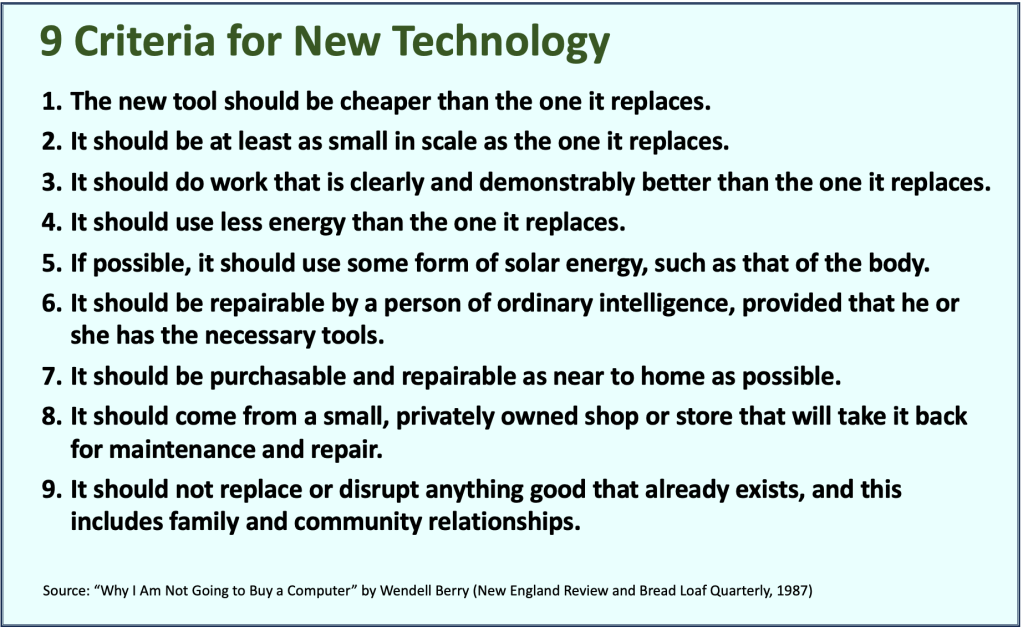
Of course, the concept of a data center didn’t even exist when Berry offered this list in the 1980s, but his emphasis was new technology should be a benefit, not a burden, to the average person.
There’s a point by point analysis of these criteria by “The Honest Broker” on Substack. If there’s a test on these nine points, Greenberg and Poe fail miserably. But it’s extremely likely the project will go through, Greenberg’s cronies will pocket tons of cash and the scars on the land they leave behind will make lives in the vicinity of the West End more miserable.
But that’s what they want, because they don’t give a damn on who gets hurt by their greed.


Leave a Reply