Data centers are in the news in Kentucky. Here’s one that didn’t go through, from WLKY:
The Meade County Planning and Zoning Commission voted not to recommend a rezoning application that would pave the way for a potential data center.
Hundreds of residents attended a special Planning and Zoning Commission meeting at the Meade County fairgrounds on Tuesday to speak against the application.
WLKY obtained the application, which requests a zoning change of more than 130 acres of land along Joe Prather Highway and Garrett Road in Ekron from residential and agricultural to light industrial.
The reason is to pave the way for a proposed IT infrastructure facility, according to the application.
The application says the facility would run 24/7 and employ around 100 people.
Many residents testified over the course of the more than four-hour meeting that they were concerned about what this center would mean for water and electric usage, noise, property value, and more.
“We are already struggling as farmers,” said one Meade County resident. “We don’t need something else to fight against. A lot of farms use well water.”
Donnie Dowell says his property backs up to the proposed site.
“They expel wastewater, which is going to go right in the ground and I’m going to pump it out. I’m on a well,” he said. “So for me it’s bad, bad, bad. All of these people standing here will tell you the same thing.”
The county magistrates unanimously voted “no” Tuesday night.
For all of us who aren’t technologically advanced, why is this an issue?
According to the American Society of Civil Engineers, the U.S. has more than 5,300 data centers that operate 24 hours a day, seven days a week, and make the digital world possible. Your Amazon order? That requires a data center. You asking AI to write your college application? Data center is required. Doing a Google search? Guess what’s happening in the background. Anything involving the electronic compilation of data means a data center is active.
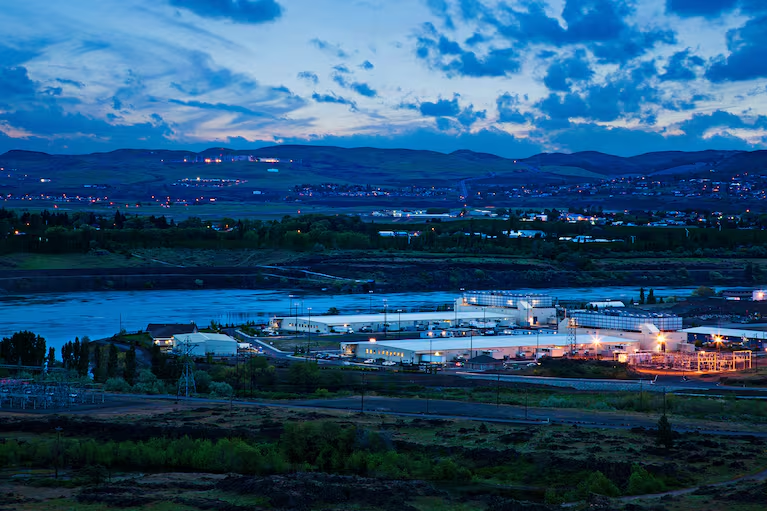
And these centers consume huge amounts of water to keep the system cooled. Here’s one example from Oregon that goes with our lead image:
In The Dalles, Oregon, for example, a lengthy legal battle ultimately revealed that Google data centers in the region consumed more than 355 million gal. of water in 2021 — an amount that had tripled since 2016 — representing more than one-quarter of the town’s annual water consumption, according to the February 22, 2023, article “Google’s water use is soaring in The Dalles, records show, with two more data centers to come” on The Oregonian’s OregonLive website.
Collectively, data centers rank in the top 10 of “water-consuming industrial or commercial industries” in the U.S., according to a study led by Landon Marston, Ph.D., P.E., M.ASCE, an assistant professor of civil and environmental engineering at Virginia Tech. That study — “The environmental footprint of data centers in the United States,” published in May 2021 in the journal Environmental Research Letters — also noted that the data center industry “directly or indirectly draws water from 90% of U.S. watersheds.”
Moreover, Marston estimates that 20% of those data centers “draw water from moderately to highly stressed watersheds in the western U.S.,” according to a February 2022 Virginia Tech media advisory titled “Researcher explores how proliferating data centers affect water supply in the United States.”
So, if it’s a battle between farms and data centers, chances are a data center is going to win, because tech firms have ridiculous amounts of money to buy off easily purchased politicians. And the situation in Meade County, where farmers realize they are in competition with tech firms, shows that some people are waking up to the fact that billionaire run tech companies don’t care what the people who provide us food need in terms of a reliable and protected water supply.
Don’t think that’s the case? How about this?
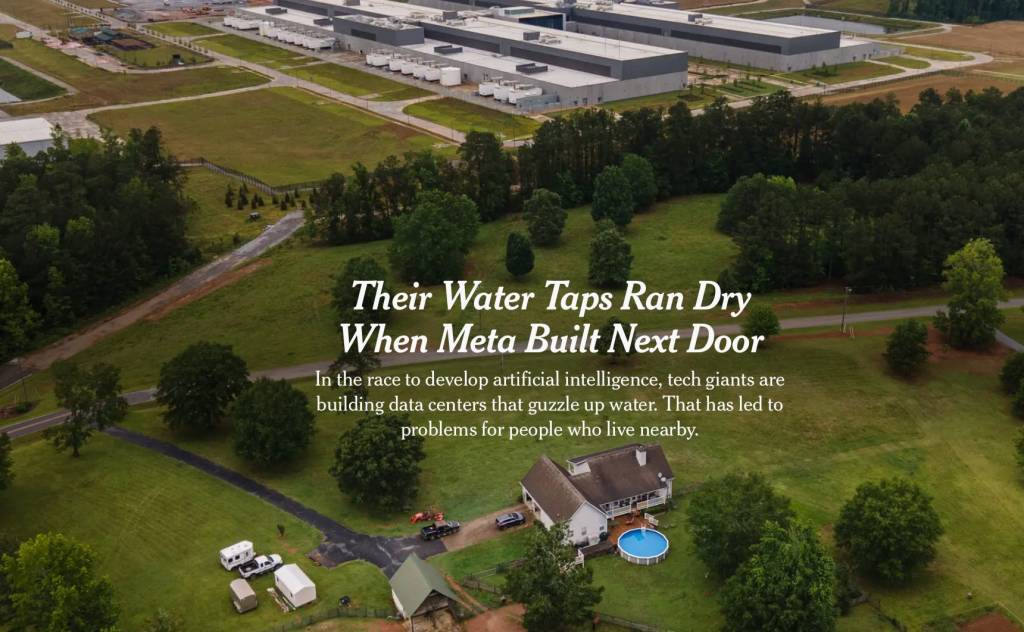
We will see a lot more of this in coming years. And the consumer will realize that water is going to become a lot more expensive.


Leave a comment